
One Asteroid, Not Many Maps
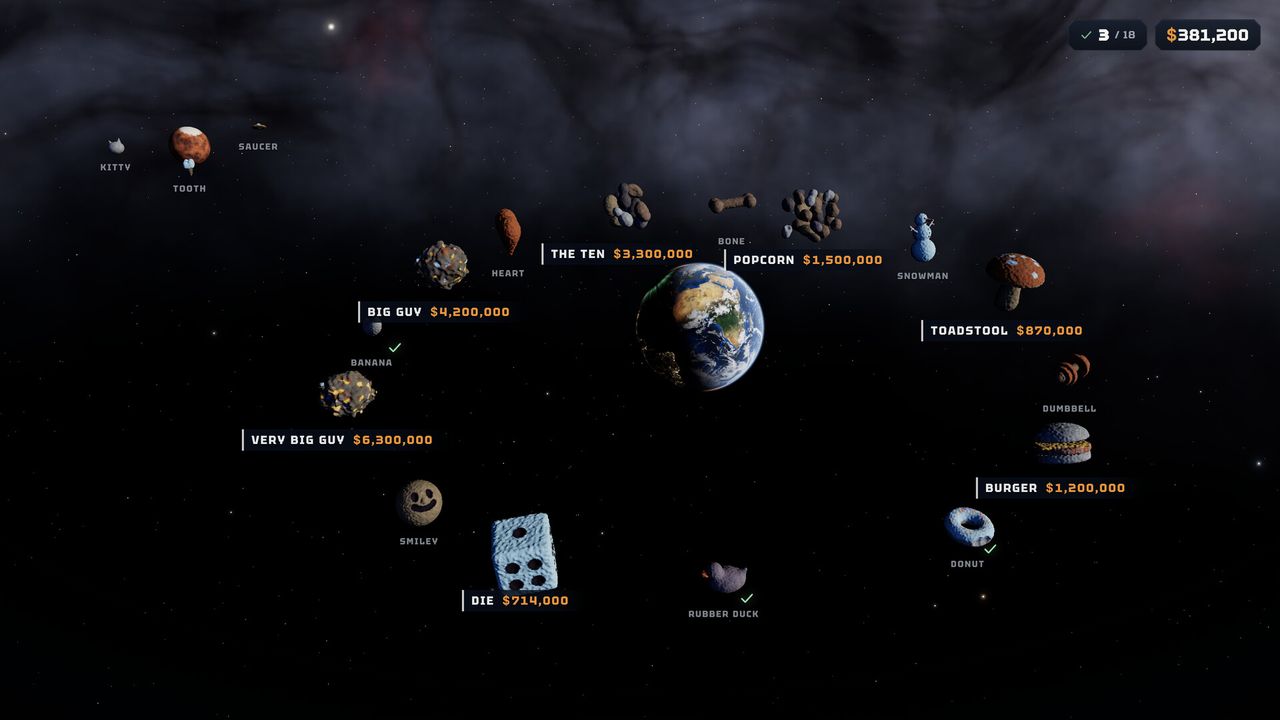
No Asteroids is built around a single 5,000,000 m³ asteroid rather than a set of levels. The 'map' is the rock itself, and it changes as you remove it.
That means map knowledge is route knowledge: where the lander sits, where the trade terminal is, and which direction leads back with the least climbing.
Post-contract client jobs add new objectives, but the core map remains the asteroid.
The Lander and the Terminal
The lander is your base, your air refill, and your launch vehicle. The trade terminal is next to it, which is why the sell-and-spend loop never requires leaving the asteroid.
Anyone inside the lander can start a ten-second countdown. That makes the lander a social hub as well as a base — and a hazard if your crew is careless.
Reading the Rock
Ore shows up as icons on the radar. Depth is shown on the HUD. The useful map skill is judging whether a signal is worth the walk given your remaining air.
Weak layers break away and create loose pieces. Those pieces change the map: a route you cleared can be blocked by debris, and a new gap can open where rock used to be.
Plan routes that you can leave without climbing. A spiral out from the lander beats a straight shaft every time.
Why the Route Home Matters
The asteroid has no fast travel. The only shortcut is the tether, which pulls you back toward the lander when you press R.
Because every trip costs a day, a bad route is not just inconvenient — it is a failed shift and a lost hold.
Experienced players mark their exit before they dig. If you cannot see or reach the way back, you are already too deep.
What We Do Not Have
We have not mapped ore distributions or published a coordinate map. The asteroid is procedural in feel and changes as you mine it, so a static map would be misleading.
What we can give you is the planning rule: shallow, wide, and close to the lander first; deep and narrow only with air to spare.